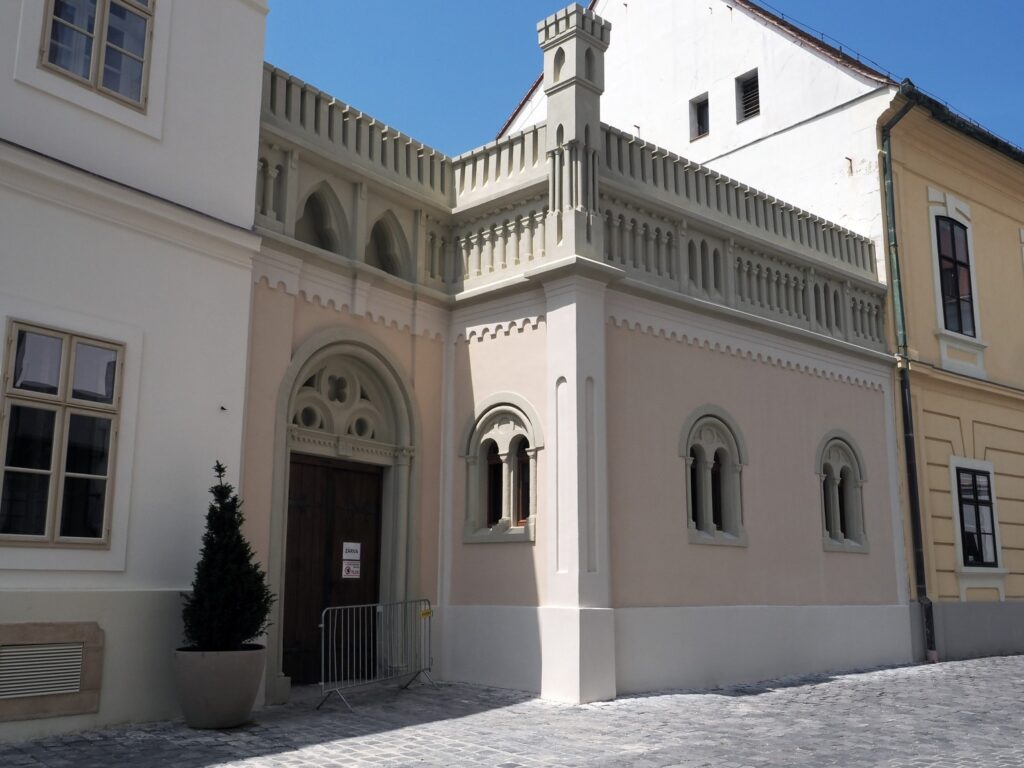
The Tejfalussy House, adjacent to the Franciscan Monastery, derives its name from its founder, György Tejfalussy (Milchdorfer), a singing canon. In its place, it is likely that two early Baroque buildings stood previously. Tejfalussy built the current two-story Baroque main building in 1772 on the site of these buildings, constructed on the double castle wall. The ground-floor annex standing next to the long, narrow courtyard can be considered as the original two early Baroque residential houses. An interesting aspect of this is that its layout evokes the characteristics of the castle before the palace constructions of the 18th century: the narrow dead-end streets, alleys, so-called "turn back" streets.
The building fits into the street line, with a stepped-back facade on its southern side, which shows a similar division to the nearby Biró-Giczey House. The residential building has an extended, irregular floor plan. Its street wing is single-story with a historicising character. The perpendicular, rectangular-shaped western wing is three stories high and carries Baroque style features. Inside the main Baroque building, there are vaulted rooms and an original staircase. The basement of the building may have previously served as a casemate.
On the upper floor, in the antechamber, during research, Baroque-era wall layers were discovered. The walls are covered with dynamically painted wall paintings imitating protruding stucco elements and tympanum decorations. Corinthian columns are visible on the side walls.
Az épületet többször átalakították, majd 1985-ben a veszprémi püspökség múzeuma és fő kiállítóhelye költözött oda. A gyűjtemény több ezer értékes műtárgyával az egyházi kincstárak második leggazdagabbja hazánkban. Itt őrziték többek között az Erzsébet királyné 1867. évi koronázási díszruhájából készült miseruhakészletet, Hornig Károly bíboros Bécsben készült pásztorbotját, és Mindszenty József veszprémi püspök tárgyait.
Az épület jelenleg megújulás alatt áll, ezért most még nem látogatható. Köszönjük türelmüket, és öröm számunkra, hogy együtt várhatjuk a megújult terek megnyitását.