Written by Dr. István Takáts
The Liturgical Space as an Invitation to Discover the Mystery of Our Existence
“I tell you, if these were silent, the stones would shout out.”
Luke 19:40
In the Gospel according to Luke, this is Jesus’ response to the Pharisees, who object to the joy of the celebrating crowd as Jesus enters Jerusalem.
The liturgical space echoes both the joy of our existence—the truth that “God is with us!”—and the truth of Jesus’ words. Through its architecture and art, it calls us to recognise that the origin and ultimate purpose of our lives extend beyond the visible world; that we are, in fact, pilgrims on our way to heaven and are “rooted in heaven” (cf. Simone Weil).
St. George's Chapel – The Beginning
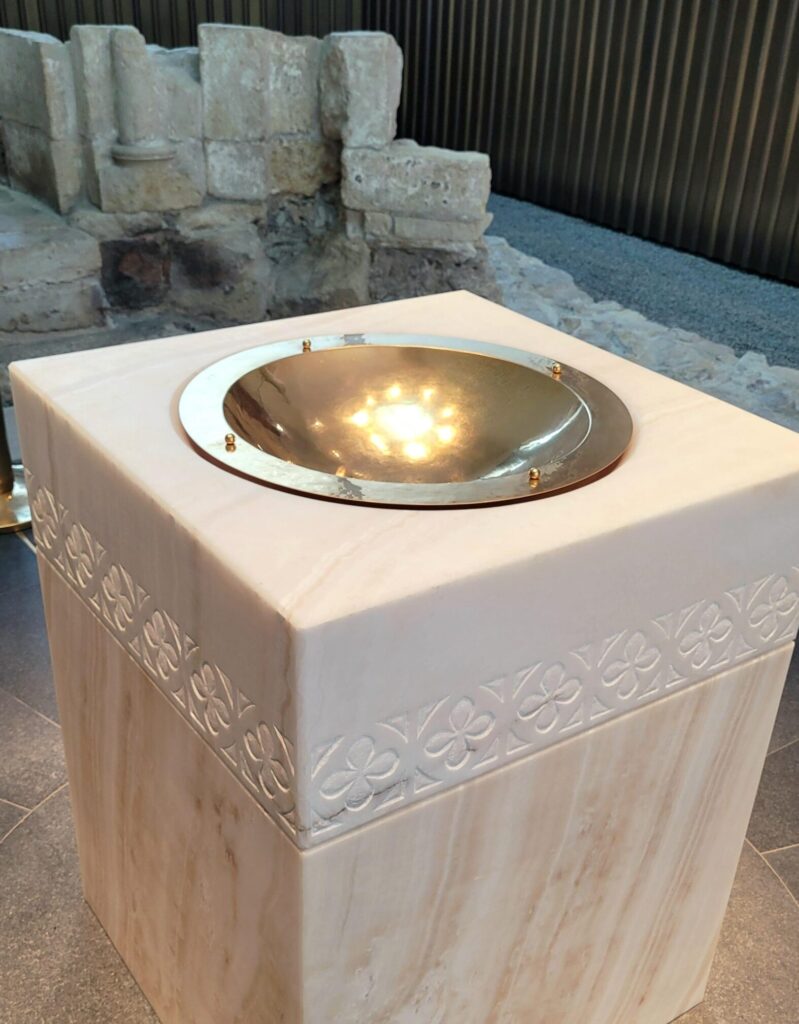
In a remarkable way, the history of St George’s Chapel itself embodies our calling within salvation history. It was already the chapel of a Christian centre before the arrival of the Magyars, and later became one of the earliest centres of Hungarian Christianity and the place where St Emeric made his vow of chastity. Completely destroyed during the Ottoman occupation and subsequently forgotten, it has now risen from its lifeless state. As the cathedral’s baptistery, it will once again become a place of commitment to Christ and of the promise of eternal life lived in the hope of the Resurrection. The evocation of the former circular and octagonal ground plans recalls the medieval walls, while also expressing the architectural profession of faith embodied by baptisteries: God created the world in six days and rested on the seventh; the number eight therefore signifies the reality beyond the created world—a reality in which the baptised person comes to share through Baptism. The square base of the onyx baptismal font likewise evokes the created world, with its four cardinal directions. Above it, however, the circular skylight represents the person who walks in the light of faith, as well as divine fullness and infinity, which through Baptism become humanity’s ultimate destiny.
Beneath the baptismal font lies soil taken from the grave of Blessed Mária Magdolna Bódi, placed here as a secondary relic. It signifies the continuity of the promise made in Baptism: the newly baptised are offered the joy of belonging wholly to Christ and the peace of a life victorious even over death.
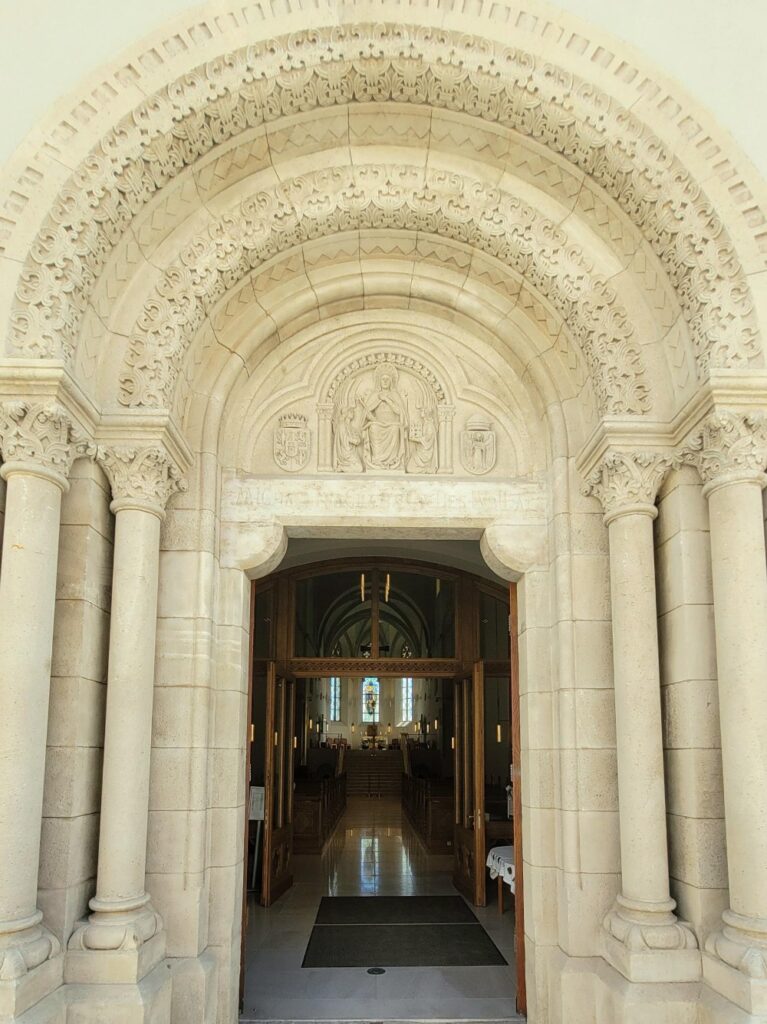
Cathedral – Gate / Holy Gate – Transition from the Profane to the Sacred
A gate always symbolizes a passageway between two states, two different worlds, often in a symbolic sense (e.g., a foreign world—home; the unknown, unpredictable—the familiar, comforting). At the cathedral, the gate opens onto mystery. It invites us to enter from the profane into the sacred, to “lift up” our hearts, and to discover the true horizons of our existence. As we cross the threshold, Chapter 10 of the Gospel of John may come to mind:
“I am the gate. Whoever enters through me will be saved; they will come in and go out and find pasture.”
John 10:9
Crossing the threshold, therefore, also expresses our decision to rely on God, to follow Jesus, the Good Shepherd. With Him, the path leads not into nothingness, but to the fullness of life.
But it is not only the path to an encounter with God that opens up, but also an encounter with the Church, the community of believers—including dialogue, reconciliation, and the celebration itself.
Holy Water Font, Ambo, Altar, Pastophorium, Tabernacle – The Path to Wholeness
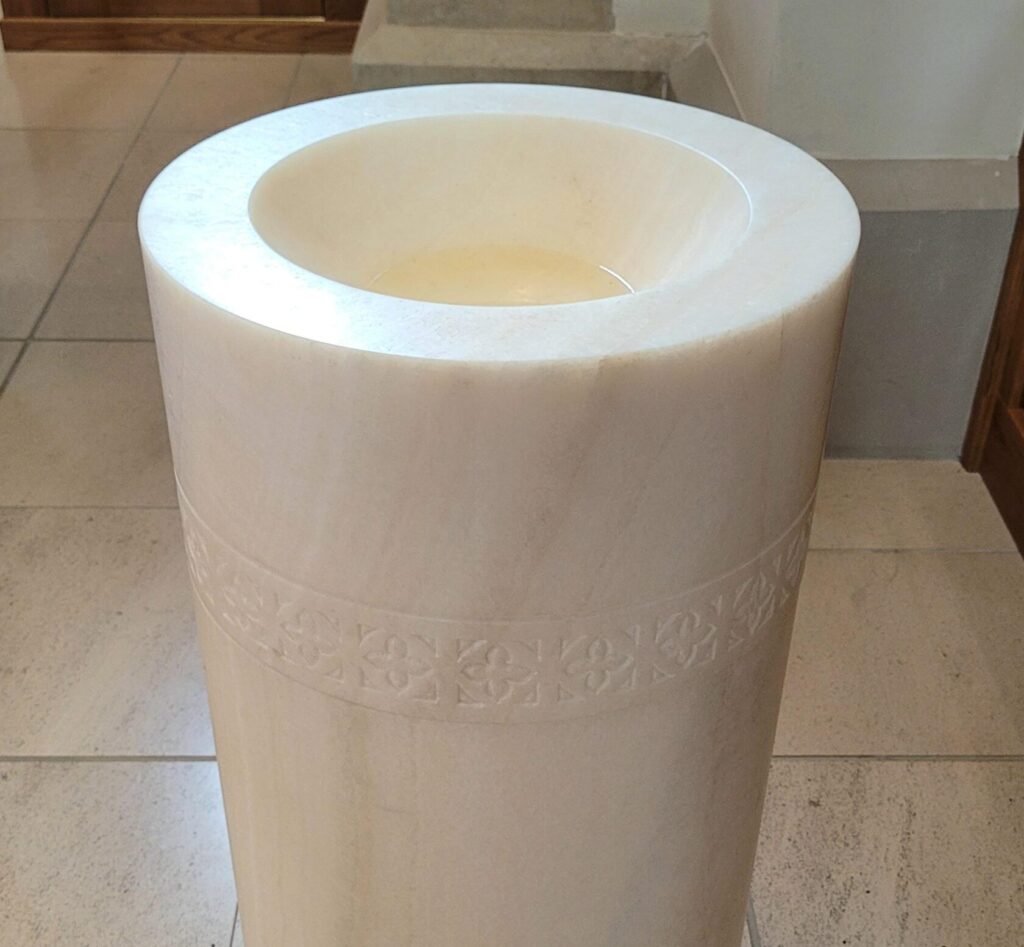
The two beautiful holy water fonts next to the main entrance evoke our baptism, our covenant with Christ, which was once sealed through water and by the power of the Holy Spirit; at the same time, they invite us to purity of heart, through which this encounter can become a celebration. For the moment of the “here and now” also foreshadows the final encounter with God: who will stand there, and what kind of person I will be when I arrive—these things are determined by the decisions I make in the “here and now.” So that there, in that final moment, it will not be sadness and pain—caused by the missed opportunities and bad decisions that have marked my entire life—that define me, but rather joy and celebration, I must choose purity of heart here and now!
The choice of materials alsomarks to the next stage of the journey: the onyx pulpit, from which the Word of Scripture and the teachings associated with it are proclaimed. The Word of God, which calls out to us again and again, helps us discover God’s enlightening and liberating truth.
This “truth” altar is symbolized by the onyx altar, where the sacrificial death of Christ—the God who loves us always—is made present in every Holy Mass. The altar, as the Lord’s “table” to which God’s people are invited, evokes not only the table of the Last Supper, the institution of the Eucharist, and Christ setting out to die for us, but also the feast of joy for those who have arrived in the Kingdom of God, thus placing the believer in the interim of love that has already begun and will one day be fulfilled (see Pilinszky, J.: *Before*).
The relics placed within the altar—those of St Stephen, King of Hungary; Blessed Gisela, Queen of Hungary; and St Emeric—express not only the ancient roots of our cathedral, our archdiocese and the faith we have inherited, but also the communion between the Church that has already reached its destination and the Church still journeying through history.
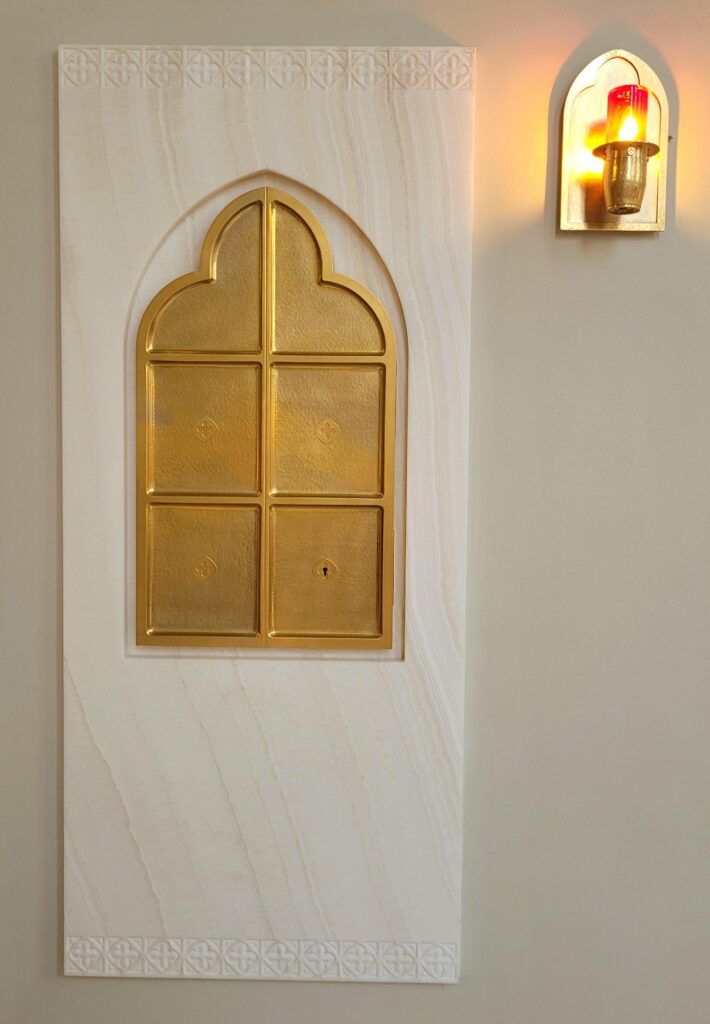
A The pastoforium, or tabernacle —reminiscent of ancient Gothic churches—is a stone-framed niche recessed into the wall of the sanctuary, the place where the Eucharist is kept, God’s dwelling among us.
“The Word became flesh and made his dwelling among us.”
John 1:14
Feeding on Him—attaining full communion with God—is the ultimate goal toward which our journey leads,
“so that God may be all in all”
1 Cor. 15:28b
The recessed placement of the tabernacle in the side wall evokes nearly 1,500 years of Christian tradition dating back to before the Reformation, while also drawing attention to the cathedral’s antiquity. The Reformation called into question the real presence of Christ in the Eucharist; in response, the architectural “creed” of the tabernacle—placed on the high altar—took shape in the 16th century, following the example of the Jesuits’ main church in Rome, Il Gesù.
The bishop’s throne, the cathedra, was thus able to resume its place in the apse of the sanctuary, signifying the seat of the diocese—and, since 1993, of the metropolitan see—as well as the teaching, governing, and sanctifying authority that the bishop exercises as a successor to the Apostles.
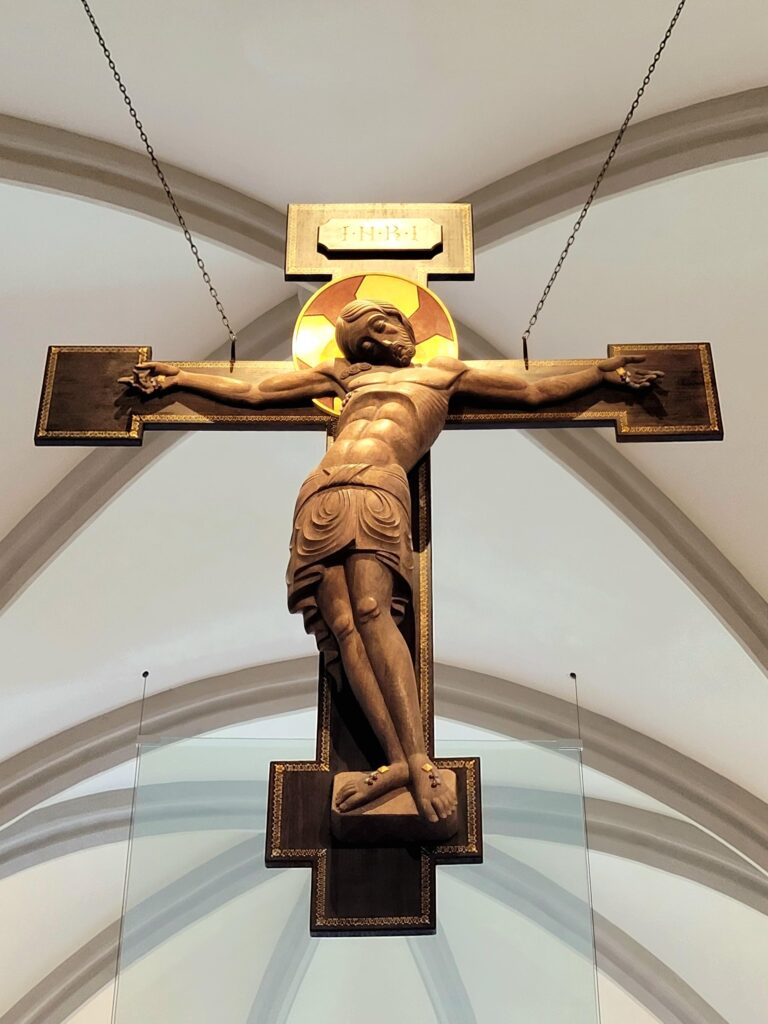
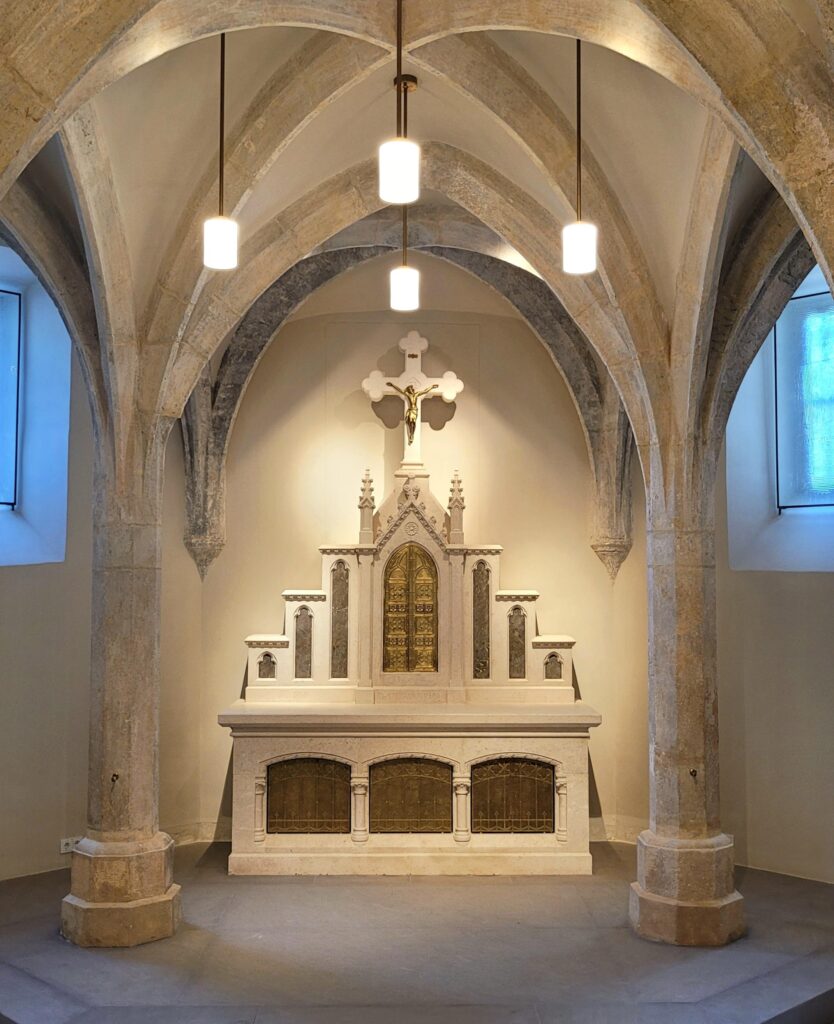
Triumphal Arch, Crucifix, Altar Cross, Eastern-style cross –“Through his death, he conquered death, and through his resurrection, he recreated life”
Just as, in the Hellenistic period, the colonnaded avenue led to the city gate, so in an Early Christian basilica the “heavenly way”—the via triumphalis—leads from the entrance to the triumphal arch of the apse, entering the heavenly city, the New Jerusalem. This is also why, during the Middle Ages, the Lamb enthroned from the Book of Revelation acquired ever greater prominence upon the triumphal arch.
In Gothic architecture, however, following a development that began in the Carolingian period, the triumphal arch came to take its name from the triumphal cross—the crux triumphalis—the crucifix suspended within the arch.
But how can the Cross speak of triumph? The first Christians already knew that, in ancient Rome, the cross was the tree of shame, the cruellest instrument of execution, and one that made Christians the objects of ridicule (cf. the mocking graffito on Rome’s Palatine Hill). They therefore avoided depicting the body of Christ upon it. Instead, the cross was adorned with precious stones—the crux gemmata. For just as a gemstone reveals its true beauty only when bathed in light, so the Cross reveals its true meaning only when contemplated in the light of faith.
We know that the Cross is the one place where Jesus was proclaimed King—through the inscription I.N.R.I. Thus, when viewed in the light of faith, Christ’s crucifixion is an enthronement, and enthronement marks the beginning of his reign. Under his rule, love is the greatest power and death becomes the gateway to eternal life. Christ’s final word from the Cross was not that everything was over, but
“It is finished!”
John 19:30a
a cry of victory that seeks to open every human Good Friday towards the hope of Easter.
Both the cathedral’s altar cross and the crucifix suspended in the sanctuary help us to see the Cross in the light of faith. Christ’s crown of thorns appears as a royal crown; his arms are outstretched in an embrace. This is the first and final gesture of God made visible towards humanity, and he does not withdraw it even when human beings drive nails through his hands. And just as, in St Francis of Assisi’s vision, Christ opened his eyes upon the Cross, so here too he is shown with open eyes, inviting us to confess, as St Francis did: for a long time I lived as though my Christ were dead, yet my Christ is alive!
The theology of the cross is reflected in the cathedral’s east-facing layout and the eastern orientation of the apse. Since the sun and light are symbols of Christ, the early Christians turned toward the direction from which they expected Christ’s second coming, in accordance with their eschatological hope.
“Just as lightning flashes from the east and is visible as far as the west, so will be the coming of the Son of Man.”
Matthew 24:27
Through the symbolic act of praying toward K, the Christian expresses that he or she does not wish to walk in darkness, but in the light of life, which enlightens every person who comes into this world (cf. John 1:9).
However, the concept of the East also expresses the theology described in the Book of Genesis. In Eden, in K, God planted a garden, with the tree of eternal life and the tree of the knowledge of good and evil in the middle (Gen 2:8–9). After the Fall, man was expelled from Paradise, and God placed cherubim at the entrance to K, with flaming swords in their hands, so that man could not return there (Gen 3:24).
The sanctuary, where Christ’s sacrifice on the cross is made present during the Mass, is located in the eastern part of the church, thus symbolizing the lost Garden of Eden and, within it, the tree of eternal life, which has once again become accessible to humankind since Christ’s sacrifice on the cross. For Christ, as the second Adam, transformed the tree of death into life through his obedience, in contrast to the first Adam, who, through his disobedience, transformed the tree of life—laden with fruit—into death.
Anchor, St. Michael the Victor—Becoming Pilgrims of Hope
At the centre of the rose window above the cathedral’s main entrance is an ancient Christian symbol: the anchor. Hebrews 6:19 uses the anchor metaphorically and, with reference to eternal salvation, calls hope “a sure and steadfast anchor of the soul,” one “that enters the inner shrine behind the curtain, where Jesus, a forerunner on our behalf, has entered, having become a high priest for ever according to the order of Melchizedek.”
Just as an anchor, once it has found firm ground, holds a ship secure even on a turbulent, stormy sea, so a believer can remain a person of hope in every circumstance, knowing that the final word over one’s life belongs not to human wickedness, suffering or death, but to the love of God.
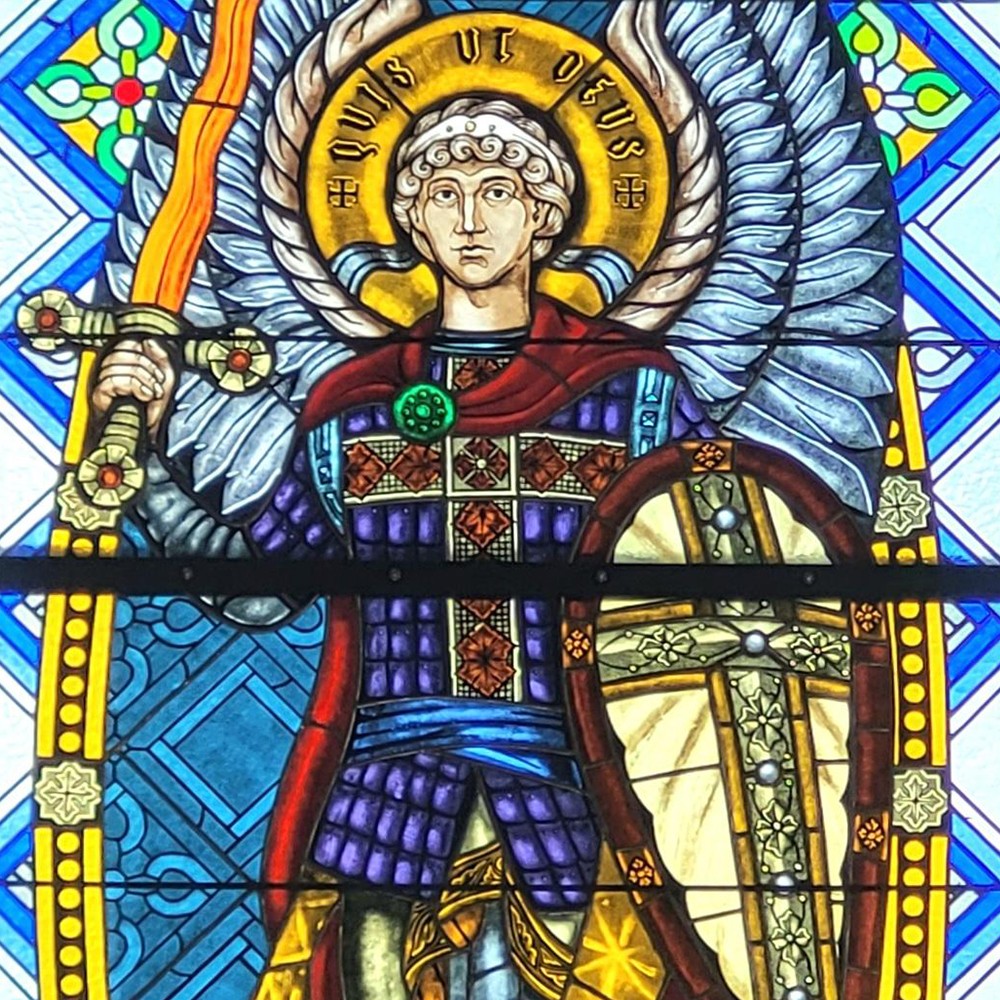
In the sanctuary’s only stained-glass window featuring a human figure, we see the church’s patron saint, St Michael the Archangel, leader of the heavenly hosts, depicted in accordance with the wishes of Bishop Károly Hornig, who commissioned the building. He is shown not in the customary way, battling the serpent that symbolises Satan, but in a gesture of victory, raising his flaming sword and calling all who enter to fight on God’s side. His name—“Who is like God?”—resounds like a battle cry above every doubt and fear in the human heart, giving hope for the struggles within and without, against discouragement, evil and the powers of darkness. The battle is still being fought, but the war has already been decided: he who is Eternal Light conquers every darkness, and he who is Life itself conquers every death.