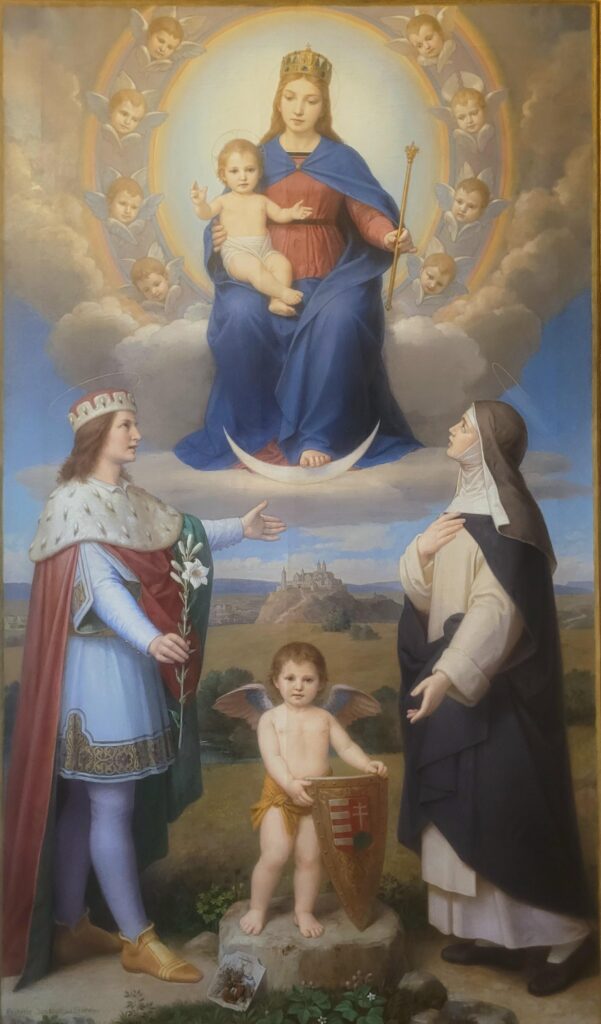
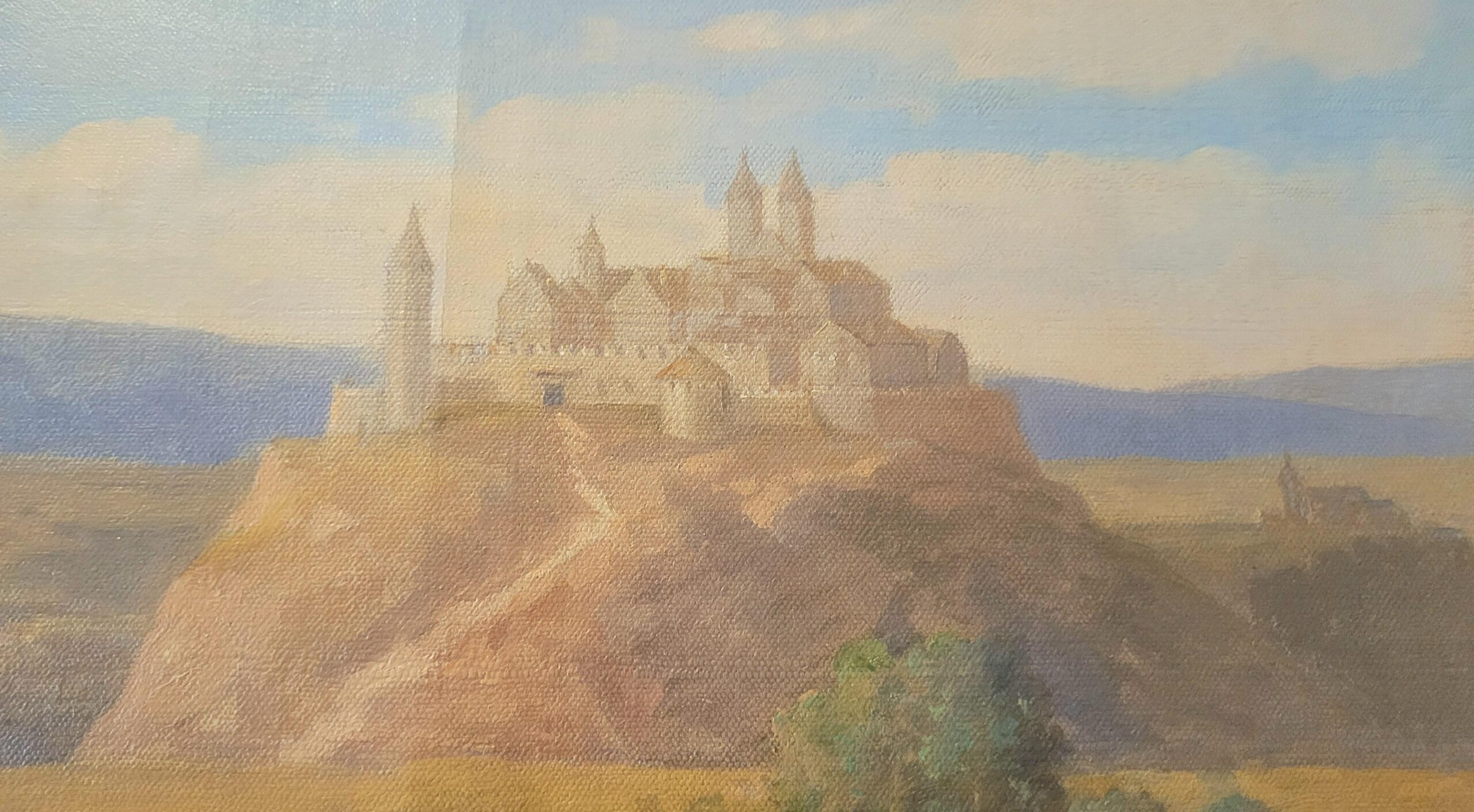
In a painting, it is sometimes the background that holds the most personal revelation. In the Archbishop’s Palace in Veszprém, for example, we can recognise the very spot where we are standing.
Behind the figures of Mary, Saint Imre and Saint Margaret of the House of Árpád, Veszprém Castle comes into view. Out there, we were walking amongst buildings; in here, the very same place becomes part of a painting depicting saints. It is worth pausing to reflect on this connection: for 130 years, this painting has linked Veszprém with the Great Lady of the Hungarians.
The artist, Ferenc Szoldatics, knew this region well. He was born in Vörösberény, attended the Piarist grammar school in Veszprém, and then studied painting in Vienna. At the age of thirty-three, he settled in Rome, where he lived for the rest of his life. However, he continued to work for churches in Hungary: his altarpieces and murals brought his art back home. Commissioned by Bishop Károly Hornig, he painted the Patrona Hungariae, that is, a depiction of Hungary’s patron saint.
The picture was taken in 1896, and this date holds a special significance. It was then that Hungary celebrated the thousandth anniversary of the conquest of the Carpathian Basin. In the same year, Pope Leo XIII granted the country a special feast day in honour of Our Lady of the Hungarians. The ancient tradition thus gained its own day in the calendar — initially the second Sunday in October. Later, the feast day was moved to 8 October.
This year, the main festival falls on a Thursday. The following Sunday, 11 October, however, is actually the second Sunday of the month: the day for which it was originally designated. This weekend, the story of a 130-year-old painting unexpectedly comes into close alignment with our own calendar.
Meanwhile, the painting had its own history within the palace. For a long time, it adorned the altar of the bishop’s private chapel. During the restoration, the earlier Baroque painting of Christ was returned to that spot, whilst Szoldatics’ work was given a place in the palace’s ornate suite of halls. It once formed part of the setting for the archbishop’s prayers; today, visitors exploring the palace can also admire it.
The ‘Light and Reverence’ guided castle tour links the halls of the Archbishop’s Palace with the Gizella Chapel. Whilst exploring the palace, it is well worth looking out for the painted castle. Then step out onto Vár Street and take another look around: this time through the eyes of a painter.